
U2 and Carnaval De Luz
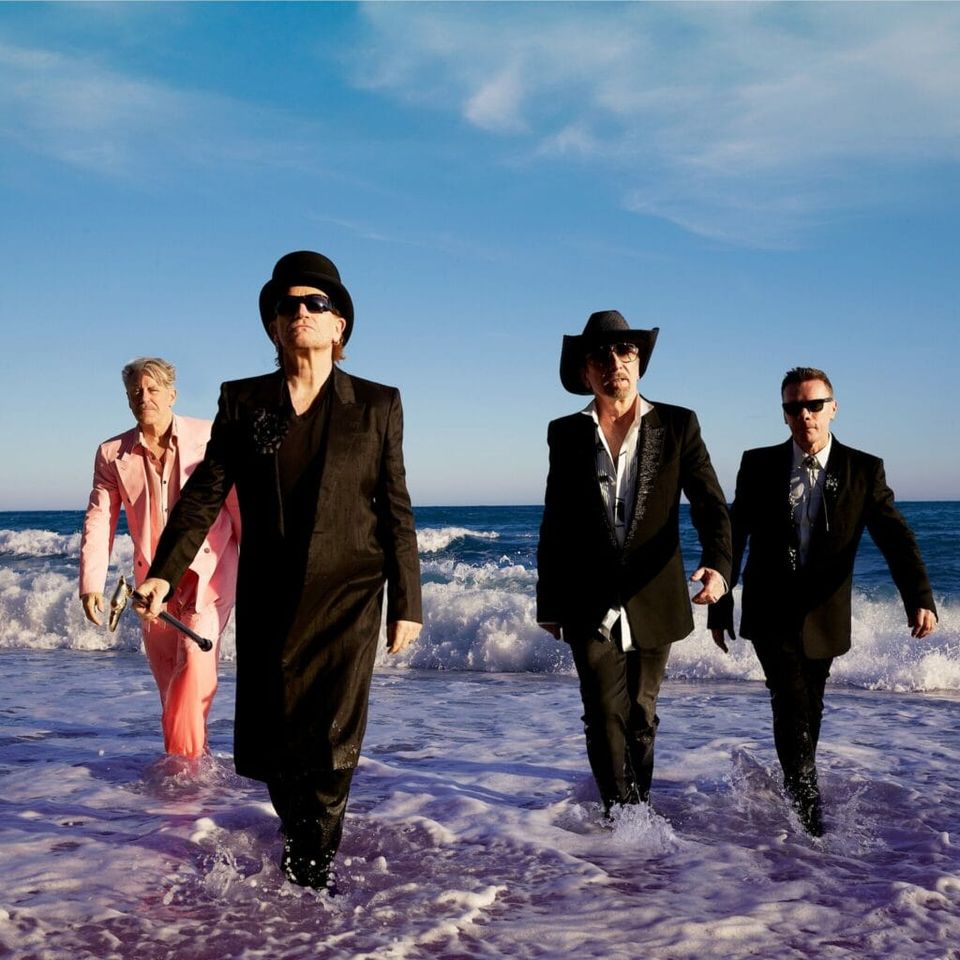
As they kick off promotion of their upcoming album, Carnaval De Luz, the four member of U2 were interviewed by Brian Hiatt for Rolling Stone.
Update: I figured out the likely reason. I didn't catch that this was Rolling Stone UK, not US when I first linked to the story. Andy Greene is with Rolling Stone US.
As usual, there's plenty of Bono'isms about the new album in the interview, but also lots of interesting reflections on the last few albums. Some funny quotes I pulled:
They apparently don't have a band text thread:
When he felt ready, he texted his bandmates. (Oddly, there’s no full-band U2 group chat. “We haven’t done that yet,” Mullen says. “Definitely should get one of them.”)
Bono on the band going back to dream it all up again... again:
“More importantly,” the frontman adds at the table, piggybacking Bono-ishly onto his own line, “every time a band like U2 goes into the studio, you sort of have to break up and make up. It’s a hard thing to say, but I think part of it’s true. Or certainly there are pivotal albums where you know you have to start again.”
Incorporating the church's liturgical calendar in the band's album release schedule:
As an upcoming deluxe edition makes clear, the whole thing is essentially a double album built around the liturgical calendar, and meant to be listened to that way: Carnival, Lent, Easter. You could also hear it as an eternal cycle, since the final sounds on the Easter EP turn out to be the first notes of Carnaval. “Trying to ask a wearied world to follow the liturgical calendar might be a lot to ask,” Bono says with a smile, “even of our most fervent fans. But maybe not. It’s an art project.”
On recording the album's final song, 'Torn', with Dolly Parton, a few months before her death this year:
He remembers Parton telling U2, in essence, “Yeah, I want to do a song. You just haven’t given me one that I can sing.”
So she sent one of her own, ‘Torn’, a tale of a woman trying to decide between two men. Bono heard potential in it, but he and Snow Patrol’s Johnny McDaid, a collaborator on the folk project, rewrote the lyrics around a mother agonising over a divide between two sons.
Larry Mullen Jr. on the band continuing with the Sphere residency in 2022 without him:
He had no issue with his bandmates continuing without him. “I absolutely understood,” he says. “Business is business, and nothing can get in the way of the process, and I accept that 100 per cent. So the unspoken rule” — that a band member could be replaced onstage — “applied to me in that case. It could apply to somebody else in another case. And that’s the cost of doing business. It is complicated being friends, being friendly, being in business. So yeah, we all have feelings. So I’m not gonna lie that it wasn’t difficult, but nobody imposed it.”
I really appreciated the section devoted to reflecting on the Songs of Innocence and Songs of Experience albums, and particularly how the rhythm section of the band are glad it's over:
Mullen and Clayton are just glad that the band changed its ways from the Innocence/Experience period, when they would ping-pong songs between wildly different producers and co-writers. “It was very hard when we had so many producers involved,” Mullen says. “So what is the band? What does the band do? How does it function?… I didn’t know what I was meant to be doing. So the studio environment was sit back and watch. I’m not used to sitting back.”
As I said with Matt on our recent chat about U2 at 50 on Daily(ish), I'm so glad to hear bass front and centre on the first two singles. That signals a great U2 album to me. And I always suspected The Edge had a hand (left one anyway) in writing some of the bass lines in U2 songs:
It’s also full of huge, song-propelling bass lines. Clayton is quick to credit the Edge with composing some of them, but the guitarist throws the praise back at him. “The thing I always know is when Adam plays, it’s a different thing altogether,” says the Edge. “So I might throw an idea at him, but it’s amazing how, when Adam and Larry play, everything goes up 50 percent just in terms of the depth and intensity and personality.”
Remembering back to the murder of Renée Good in January this year almost feels like a lifetime ago given the continual onslaught of all the things happening every day. I always assumed that the band had gotten permission from her family to write her story in 'American Obituary' on the Days of Ash EP, but the actual story is even more impactful:
The Edge started the music for ‘American Obituary’, which mourns the death of Renée Good at the hands of an ICE agent, only four weeks before it came out. Before Bono finished the lyrics, he arranged a Zoom call with three generations of Good’s family, “the best people you could ever meet.” “As chief lyricist, I just wanted to make sure people were OK with it,” he says. “And the father, when I got to the bit about ‘America will rise against the people of the lie,’ he asked me where that came from. I said, ‘It’s a book that Edge gave me, by M. Scott Peck, back in the Eighties.’” Good’s dad pointed to the same book on his shelf. “And what was so extraordinary about these people was they were trying to make mefeel at ease.” Good’s partner told Bono she prays for the ICE officer who shot Good, which inspired his lyric “I love you more than hate loves war.”
Realizing how close Larry Mullen Jr. was to not only never drumming again, but potentially being paralyzed as a result of trying to repair his neck:
Once he backed out of the Sphere, Mullen became determined to pursue surgery on his neck. But doctors wouldn’t even discuss it with him, let alone agree to perform it. There was no guarantee the surgery would work, but that was the least of it. There was a small but real chance that it could leave Mullen paralysed. “People don’t want to take a risk,” he says. “Most people were, ‘You know what? You’ve done incredibly well. Just retire. Sail off into the sunset. Why would you do this to yourself?’” Mullen’s family was against the idea, as well. I ask how he responded to them, and he shrugs: “Override it.”
...
Eventually, a young neurosurgeon in Dublin agreed to perform the operation. Mullen was grateful, though taken aback when she told him she’d take the risk on the grounds that he was “a national treasure.” “I thought, ‘Shit, OK. It’s really all going wrong now,’” he says. “‘Might be an out-of-work national treasure.’”
On the band getting older and the prospect of continuing to play live music:
In 2010, Clayton told me he had trouble picturing himself playing rock past age 65. He’s 66 now, and at his own holiday house, a striking ultra-modern structure built from scratch a few miles away along the coast, he says he’s still thinking about age and limitations. “I feel like I’ve been blessed with tremendous good health,” he says. “But you look at the passing of Dolly recently at the age of 80 — and when this cycle is finished, I’m probably gonna be 70. That time of good health is valuable. It’s probably the most valuable time you have in your life.”
And that even after 50 years in a band together, they continue to learn, and dare I say re-learn, the lesson that:
...we’ve all changed, and we all now understand something that we didn’t understand before, and that was that there is real value to U2 in its original form. It’s worth fighting for. And it’s also worth compromising for.
- Larry Mullen Jr.
I'm jealous of anyone that gets to be in a band even for one night. Writing and playing music together with others has been one of my favourite experiences in life. And getting to do that in a band for 50 years and still love the process of seeing what you can craft together is an amazing accomplishment, regardless of how many albums or concert tickets they've sold.

Member discussion